
Stainless Steel Handpan vs. Nitrided Steel Handpan? What's the Difference?
The main differences between stainless steel and nitrided steel handpans are sustain, timbre, and stability. Stainless steel and nitrided steel handpans offer two distinct playing experiences. Stainless steel is known for long sustain and resonance, while nitrided steel offers clarity, control, and strong long-term stability. The best choice depends on how you want your instrument to feel, sound, and respond over time.
Watch: Stainless vs Nitrided Handpan (Sound & Stability)
If you’d prefer to hear and see the differences directly, we’ve put together a video comparing stainless steel and nitrided steel handpans, including sound demos, build insights, and long-term considerations.
To help you make an informed choice you’ll be happy with, here’s an even more in depth look at how stainless steel handpans are different from nitrided steel handpans. A quick recap from video above:
Stainless steel handpans typically have a sustain that is long, with a bright, complex timbre. Some players choose this steel for slow, meditative playing, or sound therapy sessions.
Nitrided steel handpan instruments can vary in sustain, but they usually have a more mellow timbre. This makes them great for songwriting, rhythm practice, or playing with percussion instruments.
Below are longer playing examples of the same scale in our different materials. But make sure to read on, because there are more differences than can be just seen or heard!
Demonstration of a stainless steel handpan.
Demonstration of a nitrided steel handpan.
We prefer nitrided steel handpans in each of the categories mentioned, and we highly recommend it to new and advanced players for its versatility. But the choice is up to you!
Let’s take a closer look at some of the key terms first, and how we use them when thinking about the major differences between stainless steel handpans and nitrided steel handpans.
Stainless vs. Nitrided Handpans: Sustain & Timbre Differences
Sustain can be defined as how long a note rings, after being struck.
Timbre can be defined as the character of sound. It’s how we tell different sounds apart. Typically, timbre is often qualified with descriptive and subjective terms, like (but not exclusive to):
Ceramic, Bright, Dull, Tinny, Warm, Round, Rich
In terms of measurement, timbre is quantified by the amplitude, alignment, and the presence or absence of many frequencies in or not in harmonic relationship. The sustain and when it occurs are also a part of timbre.
Timbre can be analyzed visually using various software tools. The pictures here show a spectrum analysis. Which is, a visual representation of sound in a given moment.
Just as the timbre of a flute is different from a trumpet, the timbre of a stainless steel handpan will be different from a nitrided handpan. The handpan world is full of unique timbres, varying by material, and manufacturer.
We'll talk more about timbre differences of steels below. Sometimes these characteristics are hard to capture in video, so read on to learn more!

Where the Y axis is amplitude(decibels) & the X is frequency(Hertz). The top picture represents a spectrum analysis of nitrided (blue) vs. stainless (green) handpan, using the same note & measurement technique. You’ll see more & higher overtones in the stainless graph. These are represented by the peaks/valleys in the far right of the graph. The graphs show us the difference in timbre by materials, that our ears may hear but is sometimes difficult to qualify.
Is Longer Sustain Always Better?
Glad you asked. It’s easy to assume that longer sustain means a better handpan. But longer sustain isn’t the only way to create a meaningful playing experience.
With nitrided steel, there’s typically a bit more space between notes. That subtle separation can change how you approach the instrument. It encourages you to listen more closely, to breathe between phrases, and to play with more intention.
For some players, that sense of space creates a deeper connection to the music.
Meditation and musical expression don’t only come from continuous sound. Sometimes they come from the space in between. We’ve met people who’ve come to our workshop looking for one or the other, only to choose a material different than they anticipated. It’s a personal choice- and that’s just fine.
Stainless vs. Nitrided Handpans: Stability Differences
Stability can be defined to describe hardpans notes that:
1. Do not overly modulate when struck with varying force
2. Hold their tuning for a long time
Stability comes from careful construction through the entire handpan building process.
Stability is influenced by many factors, like steel type, thickness, heating processes, hammering, skill and more. We advise vetting your handpan builder properly- especially when making the choice between a stainless or nitrided handpan.

Now, let’s get into the details when it comes to the differences between nitrided steel handpans and stainless steel hand pans. Please note that handpans are sometimes referred to as “hand pans,” “handpan drums,” or “pan drums”. We’ve used some of those terms interchangeably to help more people find what they are looking for.
What is a Nitrided Handpan?
A nitrided handpan is comprised of low-carbon steel that has been hardened through an industrial heat-treating process. This process changes the physical properties of the steel itself, making it more rust-resistant and physically harder. A great nitrided handpan has increased strength, sustain and a “gong-like” characteristic to the sound.

All nitriding processes vary by city and country, and different results are possible due to different base materials. This means that nitriding results, across the board, will never be equal between unique builders, if they do their own nitriding.
Just as bakers have secret recipes, builders & nitriders do as well. Which, in turn, can subtly influence timbre and performance.
Generally, though, nitrided instruments have what many people describe as a ceramic sound. Handpan instruments are known for this timbre in particular, and only in the last few years have other steels like stainless started to be used.
Nitriding is a difficult process to do well, which is likely why more mass-produced instruments are not nitrided, or are nitrided, with “dulling” results. With the right process, however, nitrided handpan sound can be incredible!
Over time, we’ve found that working with nitrided steel at a high level involves far more than a single process. Material selection, heat treating, surface finish, and tuning approach all play a role in the final result. Through years of testing and iteration (including batches that didn’t meet our standards that we refused to sell), we’ve refined a process that allows the material to perform consistently in both sound and stability.
Since the sustain of nitrided handpans will vary greatly by maker, make sure to listen to the actual instrument for the best representation of sustain, without effects.
Nitrided instruments have stood the test of time. With the right building practices, these handpans are your exceptional choice for a long-lasting, stable instrument that plays well with others.
What is a stainless steel handpan?
Stainless steel has specific physical & chemical characteristics. Stainless steel, like nitrided steel, is rust-resistant. The large presence of chrome in the composition makes it inherently rust-resistant, so nitriding is not necessary.
Generally, stainless steel has high strength, and can be harder to work with (especially if it is hand hammered), and it has a much brighter timbre than nitrided steel.
Often, stainless steel handpans sound louder than nitrided steel. In fact, it’s not unusual for sustain to near 4-6 seconds. This quality makes stainless steel handpans great for slow meditative playing, but they may not be well suited for other playing styles.

Stainless steel can be overpowering when played faster, but it can be the right choice for a handpan, depending on how you intend to use the instrument. Some people love it while others may find that it sounds abrasive or leads to ear fatigue.
Newer in the handpan industry, stainless steel has become increasingly popular over the last 5 years or so.
With the right building practices, stainless instruments can have good stability. However, it’s important to note the following — many stainless instruments are made with a 1-mm thickness, which is on the thin side. That thickness choice will further:
· Increase higher overtones
· Potentially decrease the inherent strength and stability of the instrument
As building practices with this steel continue to evolve, many craft handpan builders have become quite happy with the performance of this steel for these percussion instruments.
However, we caution this: the material is simply less time-tested for stability, in particular tuning longevity over many years. This is the case especially for newer factory-produced handpans- we’ve already been asked to retune many of them.
Frequently Asked Questions
What is a nitrided steel handpan?
A nitrided steel handpan is made from carbon steel that has been heat treated to increase surface hardness and durability. This process contributes to a stable, controlled sound and strong long-term performance.
What is a stainless steel handpan?
A stainless steel handpan is made from corrosion-resistant steel and is known for its long sustain and resonant tone. It’s often used in ambient, meditative, and sound healing styles.
Which handpan lasts longer?
Both stainless and nitrided handpans can last many years with proper care. In our experience, well-made nitrided instruments tend to offer exceptional long-term stability.
What is Ember steel?
Ember steel is actually just a specific grade of stainless steel. Nicknamed by Ayasa instruments, “Ember” isn’t a steel industry term; it’s a marketing one. The main qualities of ember steel have a small effect on timbre, while having a larger impact on physical color. Many Ember type steel instruments have a purple-red color, but the color can and will vary.
Do you make your handpan instruments with Ember steel?
Yes. Ember steel is our stainless steel material, which provides a balance of warmth, clarity, and durability while maintaining the expressive qualities stainless steel is known for.

Can you spot the nitrided handpans? Hint: there’s two...
Are stainless steel handpans always gold color?
Not necessarily. The color of these percussion instruments can vary independently of the material. That’s because different grades of steel can be heated to different colors. Some handpans are even coated. Consequently, handpans can be found in Blues, Purples, Purple-Reds, Golds or Grays and more.
It’s generally a good guess that golden, straw, or purple-red hues are stainless steel type instruments.
It’s generally a good guess that greys, blues, purples, or others, are something else, like nitrided, raw, or a coated steel. Just be aware that nitrided handpans can also be gold, copper, or straw-colored!
Sometimes it’s impossible to tell what a hand pan instrument is made of just by looking at it. Therefore, it’s best to refer to the sound and description of the actual instrument to know for sure. Keep in mind some factory-produced handpans include both terms in their description, which unfortunately can be misleading.
ReCap: STAINLESS VS. NITRIDED HANDPANS differences
In summary, seven key differences can help you distinguish stainless steel hand pans from nitrided steel hand pans. Knowing these differences can help you start to figure out which type of handpan instrument may be a better fit for you.
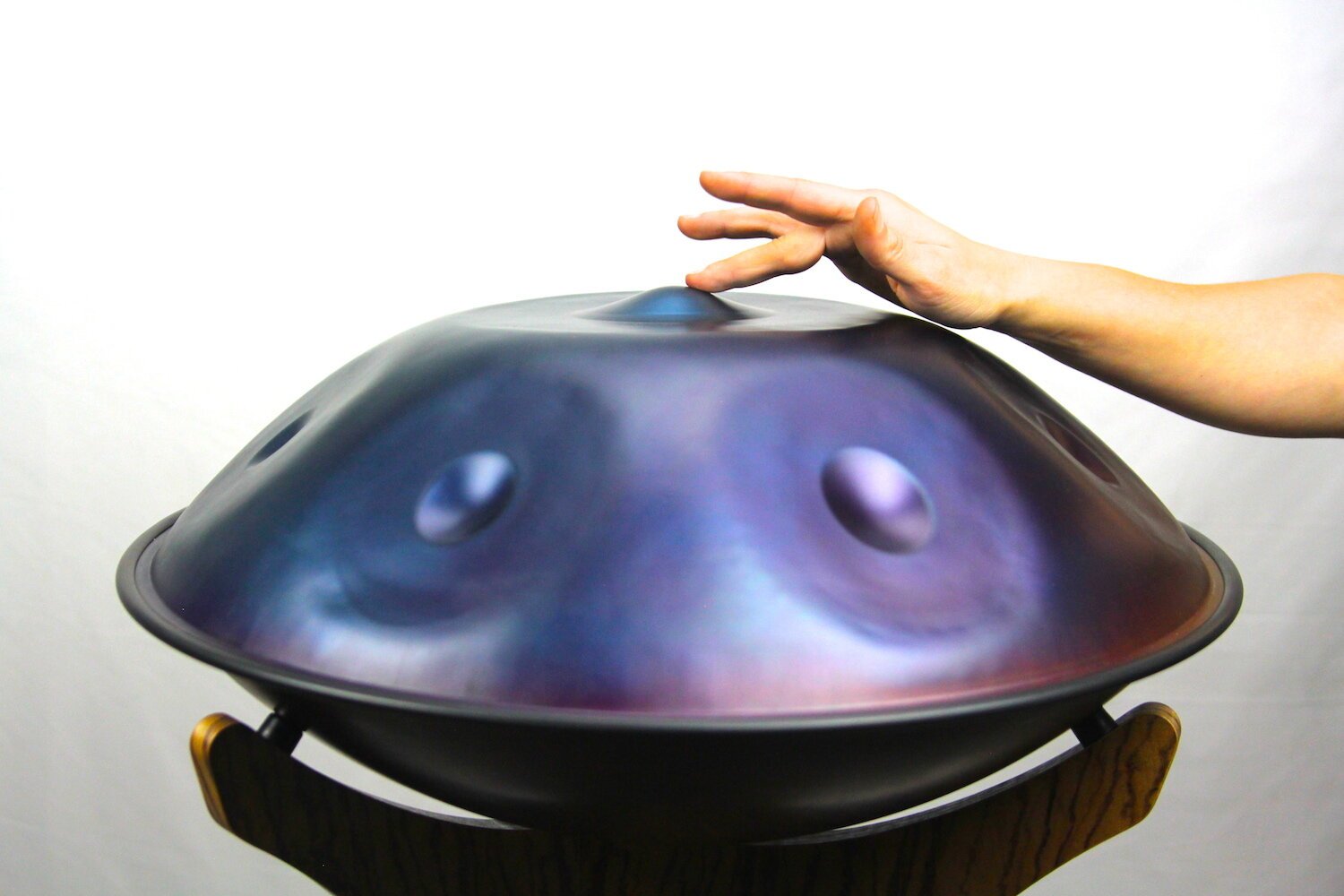
Nitrided Steel Handpans
Classic handpan sound
Great for playing with other instruments
Great for rhythmic-based playing with space between sounds
A little more technique may be required when getting started, but most beginners have no trouble getting great results
The right choice for percussion ensembles, schools, or those in collaborative music-making environments
Rust-resistant, with little maintenance required
Sustain varies greatly by maker or manufacturer
Time-tested material for instrument building
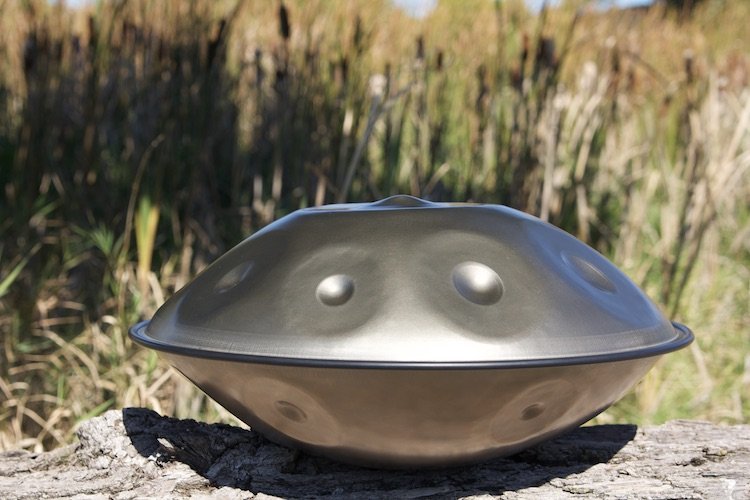
Stainless SteeL Ember Handpans
Great for meditative playing, with long sounds in between strikes
Great for Solo play
Quick to resonate
A little more forgiving for first-time players, but the sound can sometimes become overwhelming
Too many notes can make instruments become “muddy” sounding with a wall of sound
Rust-resistant, with little maintenance required
Sustain varies by maker and process but typically is on the longer end
Less tested material for instrument building, and time will tell the amount of stability by makers
Need Help Choosing a Handpan?
You don’t have to select a hand pan instrument alone. Just contact us for more info. Our team is ready to help!
Curious about materials and sound?
Explore more insights in our full handpan blog.