
D Minor Handpans: A Comparison of D Minor Handpan Scales
Are you looking for your first handpan? If so, a D minor handpan is a great choice for a beginner handpan.
Handpans in the key of D minor are the most popular worldwide. Below we’ll take a look at some of the most common handpan scale variations you will encounter when looking for a D minor handpan.
Sometimes, it can be confusing to compare handpan scales because different scale names can sometimes mean the same thing. That’s why we wrote an in depth blog about the history of handpan scale names and the 11 most popular handpan scales.
But, let’s look specifically at the most popular D minor handpan scales.
What Notes Are in a D Minor Handpan?
A D minor handpan is built from the notes of the D minor scale: D, E, F, G, A, B-flat, and C.
However, not every D minor handpan includes all of these notes. Handpan drums in d minor can come with any variety of combinations of the above notes. Different handpan scales use different combinations of these notes, which creates different musical feelings and playing experiences.
For example, a D Kurd handpan includes all of the notes in the D minor scale, while a D Celtic handpan removes the B-flat. Even a single note change like this can make the instrument feel more open, more tense, or more resolved.
Because of this, understanding the notes in a handpan scale is one of the best ways to understand how that instrument will sound and feel to play.
Watch: D Minor Handpan Scales Explained (D Kurd vs D Celtic Comparison)
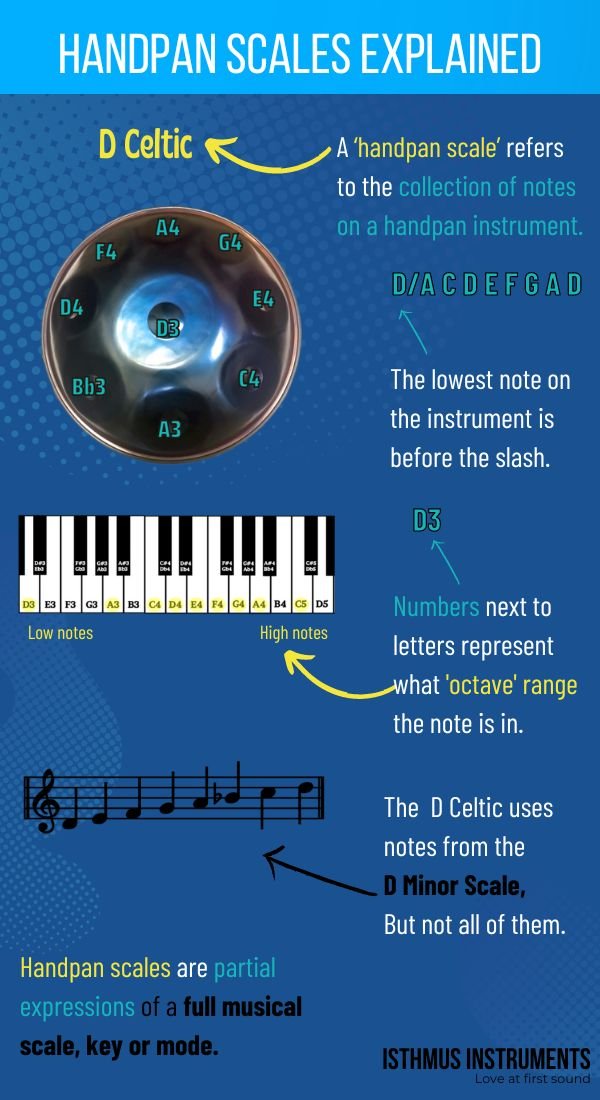
In this video, we break down the differences between D Kurd, D Celtic, and other D minor handpan scales, including how their note layouts affect sound and playability.
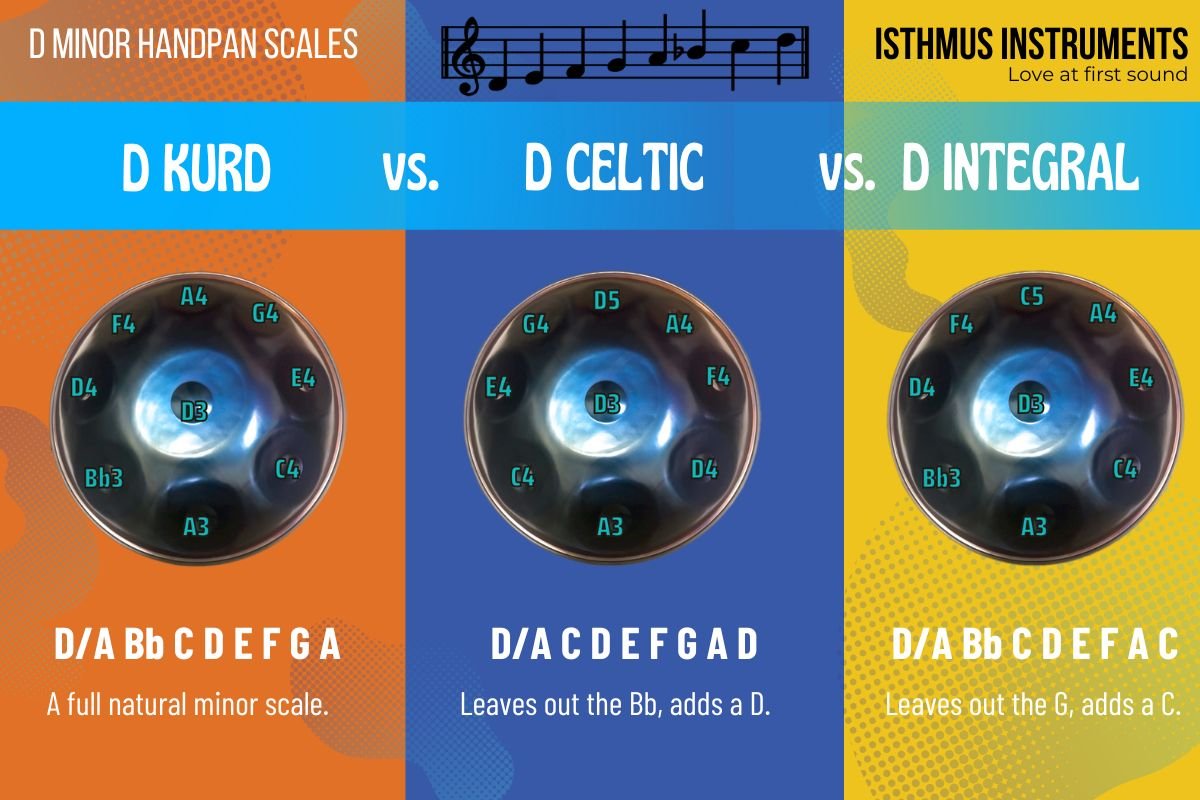
Many handpans in d minor leave out one or more notes in the full D minor scale. For instance, the D Minor Celtic leaves out the Bb, and the D Integral leaves out the G.
D Kurd vs D Celtic Handpan: What’s the Difference?
The most common comparison players make is between the D Kurd and the D Celtic handpan. Both are based on the D minor scale, but the difference comes down to the note layout. The D Kurd includes all of the notes in the D minor scale, making it a fully diatonic scale with more structure and versatility. The D Celtic removes the B-flat, which creates a more open, flowing sound with less tension between notes. Because of this, the D Celtic often feels more effortless and resonant, while the D Kurd offers more structure for players who want to explore a wider range of musical patterns. Both are excellent choices, but they provide slightly different playing experiences depending on what you’re looking for.
Now here are some other handpans in the key of D minor that you may or may not have heard of:
Other D Minor Handpan Scale Variants & Naming Conventions
This is another variation of a D Celtic (this one with a high C): D/A C D E F G A C
D Celtic (high D): D/A C D E F G A D
D Celtic (high C): D/A C D E F G A C
D Celtic 10: D/A C D E F G A C
D Kurd: D/ A Bb C D E F G A
D Kurd 10: D/A Bb C D E F G A C
D Integral: D/ A Bb C D E F A C
D Amara: D/A C D E F G A C
D Integral: D/ A Bb C D E F A C
D Waples: D/ A C D E F G A Bb
D Insen: D/A Bb D E F G A C
D Voyage: D/ F A C D E F A
D Minor: D/A Bb D E F G A C
D Annaziska: D/ A Bb C D E F G A
You’ll notice that the difference between some of these handpan scales is only 1-2 notes! Some of these d minor pan drums will play or sound very similar, while others can bring a different feeling due to the notes it includes or omits. The layout of the notes on the drum can impact how you play them.
Another thing you might notice if you look closely, is that a few of the handpan scale names are actually the same collection of notes. For example, Amara might be used in place of Celtic by some handpan makers. And Annaziska can be used for a Kurd, (although mostly builders use it for handpans in the key of C#).
We highlight this because the handpan industry is so new that there isn’t scale standardization in building or naming yet. So, the best way to know what notes you are actually getting on your handpan is to look at them!
How Many Notes Are on a D Minor Handpan?
Another important difference you’ll notice is the number of notes on a handpan. You might see variations like a D Kurd 9, 10, 12, 14, or even 16.
The number refers to how many notes are physically on the instrument. As more notes are added, they are typically additional notes from the same D minor scale, often extending into higher or lower octaves. This means that even though a D Kurd 10 and a D Kurd 14 are different instruments, they are still built from the same D minor foundation.
The difference is the range and flexibility available to the player, not the underlying scale itself.
Check out the below videos that show our extended range d minor handpans. These instruments feature a deeper low end by adding bottom notes. And the D Kurd 14 even adds notes in the higher range, so some extended models span multiple octaves.
D Kurd 14 handpan: D/ (F G)A Bb C D E F G A C (D E)
Our D Celtic 11 includes the notes: D/(F G)A C D E F G A C This instrument has 11 total notes with an extended lower range.
Frequently Asked Questions about D Minor Handpans
What notes are in a D minor handpan?
A D minor handpan is based on the notes D, E, F, G, A, B-flat, and C, though different scales include different combinations of these notes.
What is the difference between D Kurd and D Celtic handpans?
The D Kurd includes all notes in the D minor scale, while the D Celtic removes the B-flat, creating a more open sound.
How many notes does a handpan have?
Handpans can have anywhere from 7 to 16+ notes, depending on the design and scale.
which d Minor handpan is best for beginners?
The “right” choice for this will vary depending on what variation sounds best to you! The D Kurd excels for online learning & technical feel, while the D Celtic is pure magic with it’s open and expansive feel, welcoming new players to explore. The difference between these handpan scales comes down to both their note layout and how those notes interact. It’s these small differences in notes that causes so many players compare D Kurd vs D Celtic when choosing a D minor handpan.
Does note choice matter?
The only thing that matters in your note choice is if you enjoy the sound! If you are playing with a group of people or composing music it may be more important to get a particular set of notes. For anyone else, let your ear and soul tell you which D minor scale is the best first for you.
What if I can’t find the exact number or type of notes used in a demo?
This is a common problem that we hear about a lot. Perhaps you are taking online lessons or playing along with videos to learn songs and realized that when you play the exercises they sound “off” or “wrong” with your recording. This is because of those small scale differences we talked about above!
It is very important to remember that these exercises are not meant to purely sound the same, they are really meant to help you develop as a player and give you new ideas to explore on your own.
So before you give up one handpan for another, remember the following:
Different scales evoke different feelings, and that’s part of what makes the handpan instrument unique & interesting
All video exercises can be played on any handpan - exercises will help you develop as a player and can be done on any instrument regardless of notes
Listening to more than one track or video of a handpan will give you a better understanding of it’s feeling
Each small handpan builder may have their own recommendations on which version of D Minor handpan will will sound best based on experience
Learn the technique or rhythm and then put it on your handpan for the unique sound of your scale. This will allow you to pick the scale that you really connect with and use any instructional video that you like!
What IS THE MOST POPULAR D MINOR HANDPAN Today?
As of 2025, the D kurd 9 or D Kurd 10 has become the most popular handpan scale. But remember popular doesn’t mean best!
A Closer Look at 3 D Minor Handpan Scales
Diving in a little deeper, let’s take a look at some different D minor handpan scales and notes below.
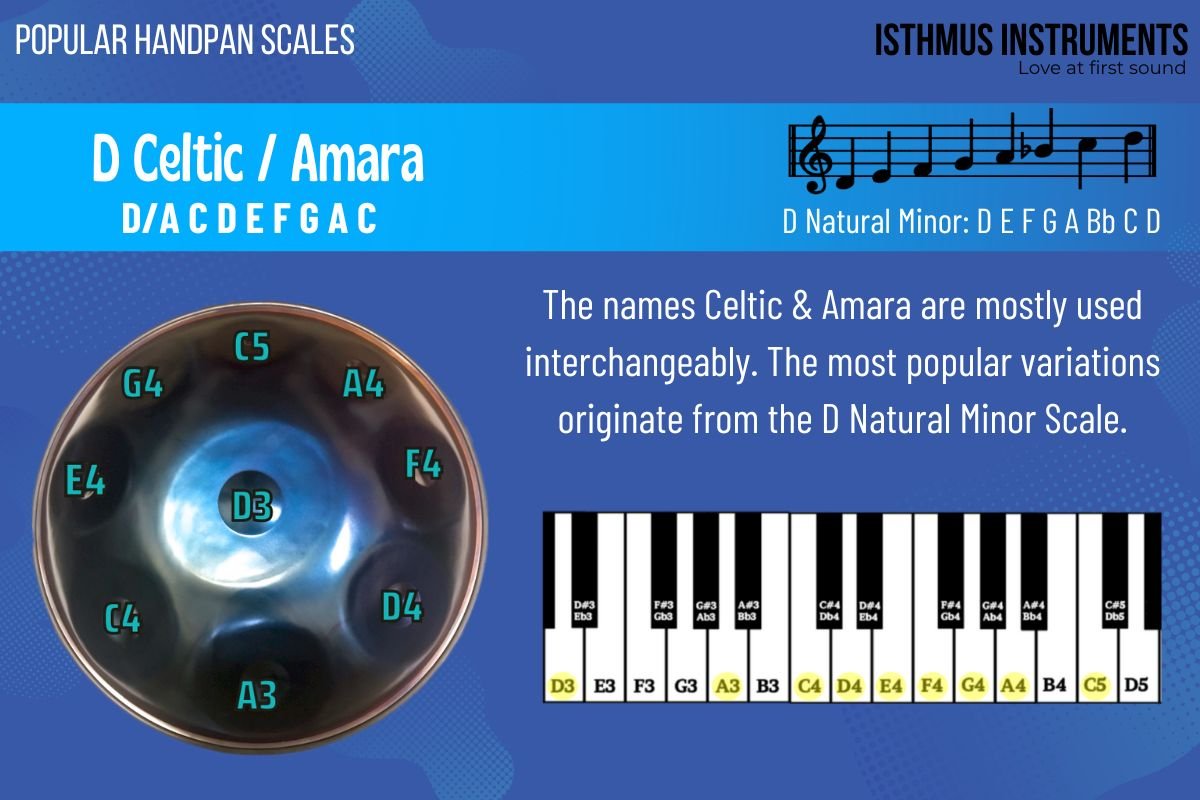
1. D CELTIC MINOR, Also Called AMARA
Compare the notes of a “D Celtic” to the key of D minor, and you’ll see that the Bb is missing! This is one of the best handpans for beginners, and it originates from a traditional “Celtic” scale. Leaving out the “Bb”, this makes this a hexatonic scale that still sounds minor. This results in a very pleasing, peaceful, and insistent scale. This is one of our favorite scales to build and recommend for beginners. We love the paired octaves in this scale which can make if feel more lively or bright than the D Kurd. You can find this scale and accompanying learn to play videos on it in the Hal Lenoard Handpan Method Book.
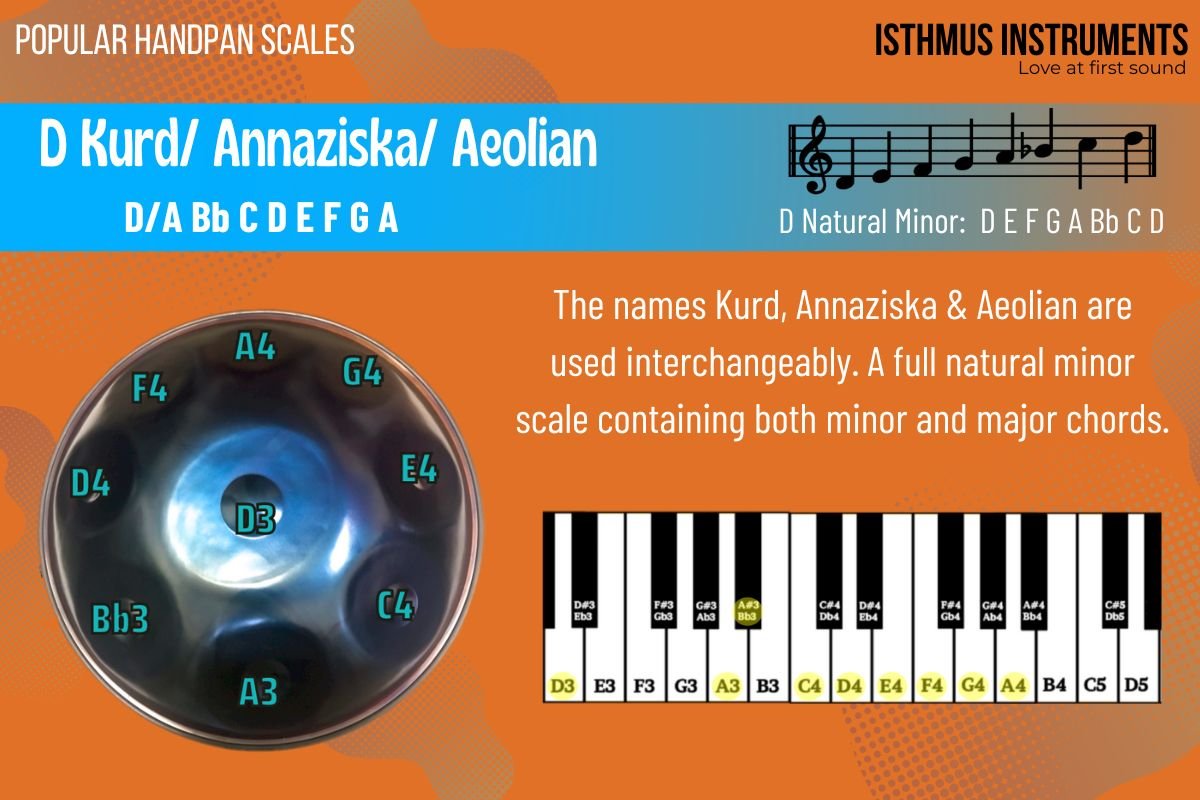
2. D KURD, ALso called ANNAZISKA, AEOLIAN
The Kurd scale is a full natural minor handpan scale, which means it has all the notes in the key of D minor. This is another popular handpan drum for beginners because it is Diatonic. The full scale allows for many minor and major chords to be played, making it fun to explore for any player. In the last few years, popularity of the D Kurd 10 has exploded. We attribute this to both the arrival of handpan factories in China, and the amount of beginner handpan courses being made for this scale today on places like masterthehandpan.com. The D Kurd 10 adds a high C5 to the notes listed below, which shows the 9 note version.
3. D INTEGRAL
The Integral is another version of the D minor scale, but in this case, the 4th scale degree, G is left out. This scale isn’t quite as popular as the first two mentioned anymore, but it's an exceptional handpan for beginners. It was much more popular in the 2000s to 2010’s when the handpan instrument was so new. Youtube videos of street performers playing this handpan fascinated onlookers, and this scale may be one reason the handpan has become so popular today! As one of the earliest scales, the Integral handpan scale helps exemplify how beautiful and complex crafting a scale can be. By changing just one note, you can evoke a whole different feel or vibe from the handpan and set of notes chosen.

Find Out More About Handpan Scales, Beginner Handpans & More
Keep exploring these resources to grow your knowledge of handpans:
And don’t hesitate to reach out and contact our handpan builders directly, via chat, email, or phone, calling (608) 504-7754, to get more answers or to schedule a visit to our workshop


